10 Minutes or Two Hours? This App Shows Hoosiers How Long They’ll Wait to Vote
You can check traffic before heading to work and track your food delivery down to the minute. But when it’s time to vote, how do you know how long you’ll spend in line?
That’s the idea behind Vote IN Time, a free web-based app created by a small group of Indy tech workers that lets voters see estimated wait times at polling locations across the state.
According to MIT’s Election Performance Index, Indiana voters waited 21.2 minutes on average to cast their ballots in 2024. That average, however, doesn’t capture how volatile the experience can be from one polling location to another.
“Is this going to take me 10 minutes or is this going to take two hours?” says Roger Deetz, CEO and co-founder of Vote IN Time. “That’s a real barrier for folks.”
Deetz was part of a group that first envisioned Vote IN Time during the 2020 election, when the COVID-19 pandemic made in-person voting especially challenging.
“What if we had the Disney FastPass for voting, where you can see where to go and how long it’s going to take?” Deetz recalls the group asking.
Six years later, the idea has grown from a volunteer-powered experiment into a statewide resource available to voters in all 92 Indiana counties.
From a Scrappy Idea to a Statewide Solution
Before there was an app, there was a group of Indianapolis tech workers looking for a way to make a difference.
“We’d kind of just been feeling the itch of like, ‘What can we do? How can we help democracy in general?’” Deetz says.
Voting already takes planning, especially for Hoosiers balancing work schedules, transportation and family responsibilities. Long or unpredictable lines make the process even more erratic.
“Not knowing how long it’s going to take or where to go is a real barrier,” Deetz says. “That was a barrier we thought we could apply some technology help to.”

The first version, called Indy Vote Times, was a web app powered behind the scenes by spreadsheets and volunteers who manually counted voters at polling locations.
“We rallied to put together a V1, which was very duct tape and volunteer-powered,” Deetz says. “It was a scrappy, very grassroots effort.”
But the initial response exceeded expectations. Indianapolis voters embraced the app during the 2020 election, giving the team confidence their concept had real potential.
“We had a ton of people use it in that election,” Deetz says. “There was a great demand, and that kind of gave us the inkling of product market fit.”
The challenge became figuring out how to make it work on a larger scale. Ahead of the 2024 election, the team rebuilt the technology around crowdsourced data, eliminating the need for volunteers to manually monitor polling locations.
In 2024, the updated platform expanded to five counties (Marion, Hamilton, Allen, Boone and Vigo) and reached 70,000 users. Its self-reported data showed just how much wait times can vary: voters averaged 26 minutes in Marion County, 41 in Boone, 59 in Allen and 74 in Hamilton.
Making Voting as Easy as Possible
The success of the 2024 expansion set the stage for an even bigger undertaking.
“Thinking about the 2026 midterms, we set ourselves an ambitious goal and said, ‘Can we take this everywhere in the state?’” Deetz says.
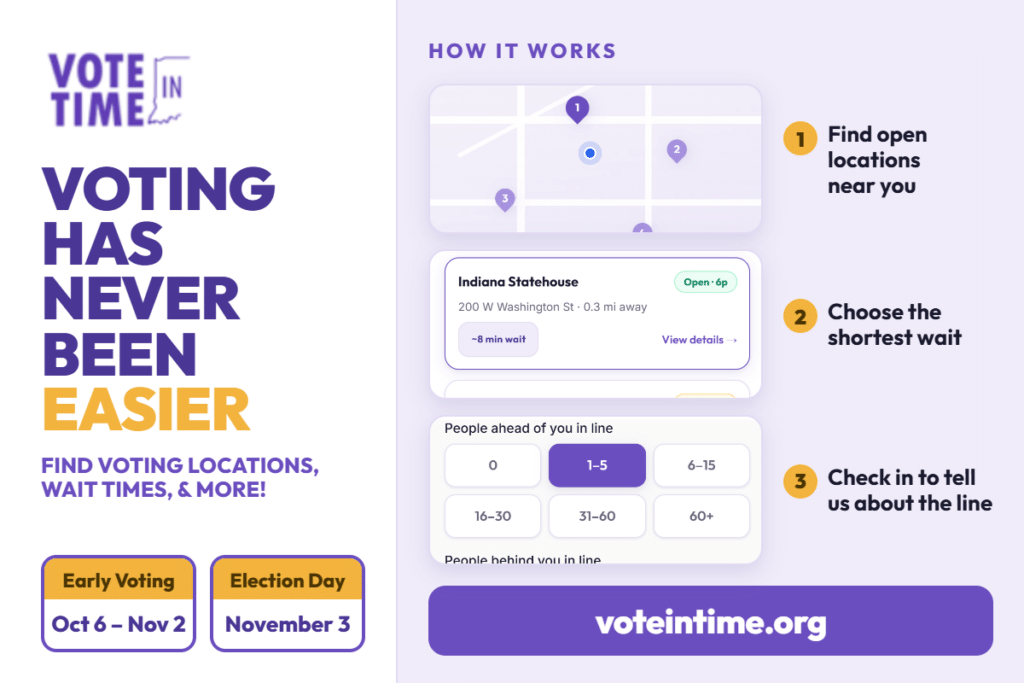
Launched statewide on October 6 to coincide with early voting, the app now helps Hoosiers find polling locations and check estimated wait times across 92 Indiana counties, all without creating an account or downloading anything.
Using the app is straightforward by design. Voters share their location, enter an address or browse by county to find nearby voting centers. The platform displays polling location schedules, estimated wait times and links to Google Maps.
While standing in line, users anonymously report how many people are ahead of them and how many are behind them. After voting, they close out the session. The app uses that information, along with the time spent in line, to calculate how quickly voters move through the polling site and estimate wait times for others.
“The data gets better the more people use it,” Deetz says. “We definitely prioritize making it as easy as possible for people to get in and contribute.”
Privacy was another priority from the beginning. The app doesn’t collect names or contact information, and users who choose to share their location to find nearby polling places don’t have to worry about that information being stored.
“We’ve taken a very privacy-first aspect to it,” Deetz says. “People deserve privacy in their vote, and they don’t want to be inundated with text messages or emails.”
Vote IN Time is also nonpartisan. It doesn’t endorse candidates, political parties or ballot issues. Its purpose is simply to give Hoosiers information to make voting easier.
“All we’re doing is showing you the voting locations and directions to them. We’re not endorsing any candidate or any issue,” Deetz says.
Powered by Indiana Tech Talent
Taking Vote IN Time statewide meant gathering accurate information about when and where Hoosiers could vote.
While Marion County maintains a relatively accessible online directory of polling locations, Deetz says smaller counties often publish early voting schedules in PDFs buried several pages deep on government websites. Collecting and verifying that information across 92 counties was a significant undertaking.
The team used Claude and custom-built tools to search county websites, extract polling location schedules and organize the information for review. But they made sure humans had the final say.
“Even though AI has been a big help in building the software, this is obviously very important information to get right,” Deetz says. “We wanted to have humans validate and review that information.”

Vote IN Time is a project of IN Tech for Progress, a 501(c)(3) nonprofit. Its core team includes three co-founders: Deetz, who serves as CEO; his wife, Amber Deetz, who serves as chief of staff; and John Ellis, who serves as CTO. Deetz’s full-time job is CTO at Blueprint, an AI platform for mental health professionals.
Over the years, they’ve tapped their connections across Indiana’s tech community to recruit former colleagues from companies including Angi, Springbuk, Anvl and High Alpha. Deetz estimates roughly 10 to 15 people have worked on the project, lending their expertise in software development, design, marketing and other areas.
“They’re all Indiana tech folks, all folks who care about the state,” Deetz says.
What’s Next for Vote IN Time?
With Election Day approaching November 3, Deetz and his team are focused on getting the word out and encouraging more Hoosiers to use the app.
The team plans to bring Vote IN Time back for the 2028 presidential election, when turnout is expected to be higher. Future enhancements could include expanded voter guides and additional election information, building on existing integrations with resources such as Vote411.org.
Taking the technology beyond Indiana is another possibility, although the team has no concrete expansion plans. For now, Deetz remains focused on the mission that inspired Vote IN Time six years ago.
“Our goal in this, number one, is just to have people vote, make it easier for people to get out, to express their interest and express their policy preferences,” he says.
Visit Vote IN Time to find polling locations and check available wait estimates on or ahead of Election Day.