Two Sides of the Same Problem: How Crowfly Was Built
This article is part of a series of profiles highlighting founders across Indiana’s tech ecosystem.
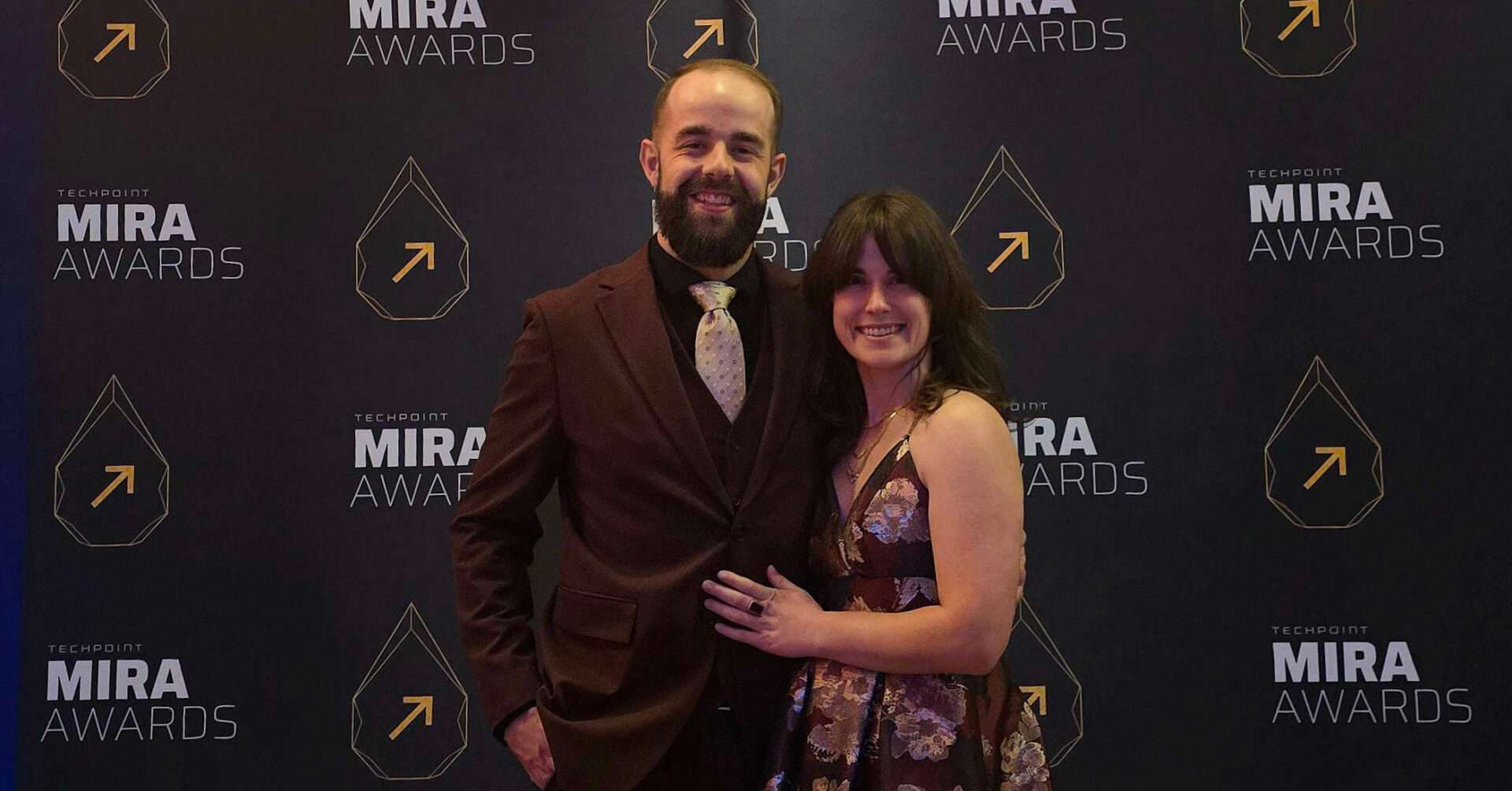
Last year, Jacqui Peterschmidt and Nickolai Christiansen co-founded Crowfly, an Indianapolis-based field service management platform built for solo and small field service providers. Before Crowfly, Peterschmidt spent years around competitive horse shows, often waiting on farriers, vets and other providers to arrive at the barn. Christiansen spent years on the other side of that equation, as a traveling IT technician racing between customer appointments for a managed service provider.
Those two vantage points, on the same underlying problem, became the idea behind Crowfly. The company started last November as a consumer app before the founders pivoted to field service management earlier this year. We spoke with the founders to talk about that pivot, why they’ve chosen to stay unfunded and the $20 bill framed on their office wall.
Was Crowfly the plan from the start, or did it take a while to get there?
Jacqui: We started our company, Upstairs Office, last November with a different idea, a consumer-focused mobile app. Some consulting work came our way not long after, almost by accident, and that ended up shaping everything. By February of this year, we’d started the real work on what’s now Crowfly, a field service management platform built mostly for solo providers, anyone who comes to your house to do a job.
The idea had been kicking around in my head for a while before that. I show horses competitively and have my whole life, and unlike most services, you don’t bring your horses somewhere to get help, the provider comes to you. After dozens of hours spent waiting at the barn for people who were sometimes dealing with emergencies clear across the state. I kept thinking there had to be a better way to solve this.
Nickolai: I’d seen the same problem from the other side. Before Crowfly, I worked for a managed service provider as a traveling IT technician, essentially an outsourced IT department for companies too small to have their own. I’d go from customer to customer all day, and I know firsthand how hard it is to make it from one appointment to the next on time. Once we put our heads together with the tools available today, we were able to make it happen.
When did the idea stop being just an idea and start being something you were building?
Jacqui: Probably early February. We’d just wrapped up a high-stress consulting project, a booking platform for a friend of Nickolai’s in Denmark who runs a music studio, on a tight turnaround. Once we came out of that, we relaxed for about a week, and then I remember thinking, wouldn’t it be cool if we made this real? By late February, we’d made the call to pivot away from our original idea.
Nickolai: We went to our first Indiana Founders Network meeting still calling ourselves Upstairs Office, pitching a language-learning app. By the next meeting, it was Crowfly.
Indiana Founders Network
A peer-to-peer network for tech founders.
Field service platforms have historically been built for medium to larger businesses. What did the gap you saw look like?
Nickolai: Nobody’s really building specifically for the smaller operators, people fresh out of high school starting their own field service business or folks who’ve been doing it solo for 10 to 15 years and are happy keeping it that way. A lot of the bigger platforms are simply cost-prohibitive for them.
Jacqui: That’s the gap we’re closing. We want on place to run your business, where we’re pulling as much of the administrative burden out of the equation as possible, because running a business alone is hard, and running one with two people isn’t exactly easy either.
What’s been the hardest part of building this company as just the two of you?
Jacqui: Doing everything. It’s the same challenge we’re trying to help our clients solve: accounting, legal, marketing, managing customer and business relationships and keeping it all in one place. One of our mentors told us about his goal for every founder he works with is to keep them in their “zone of genius.” Marketing and accounting are decidedly not in ours.
Nickolai: The hardest parts are the things we don’t know how to do, the stuff that takes research, skill and talent that’s genuinely hard for one person to have all of it. It also gives us a lot of empathy for our clients, because they’re doing the exact same juggling act.
You’ve chosen to stay unfunded so far. Why?
Nickolai: We’re not opposed to it forever, and we don’t want to alienate potential investors down the road. But the moment you bring investors in; the focus tends to shift hard toward revenue and growth: getting as many customers as possible and maximizing what you can get out of them. Staying bootstrapped lets us focus on our customers instead, including people coming out of high school who might not have $200 a month to spend right away because they’re starting their own business too.
Jacqui: Several of our competitors started out focused on the smaller end of the market, took on funding, then moved upmarket and left that segment behind. Solo entrepreneurs are underserved, which is an opportunity for us, but we don’t want Crowfly to follow that sane path.
Has a customer ever changed how you think about the product?
Nickolai: Constantly, about every week. Our first customer, and still the one we work most closely with, is Brian Woodward, who cleans dryer vents mostly on the north side of Indy. He asked if we could help optimize his driving time between multiple appointments in a day. That had never occurred to us as something that belonged in the product, and it’s completely reshaped what we focus on.
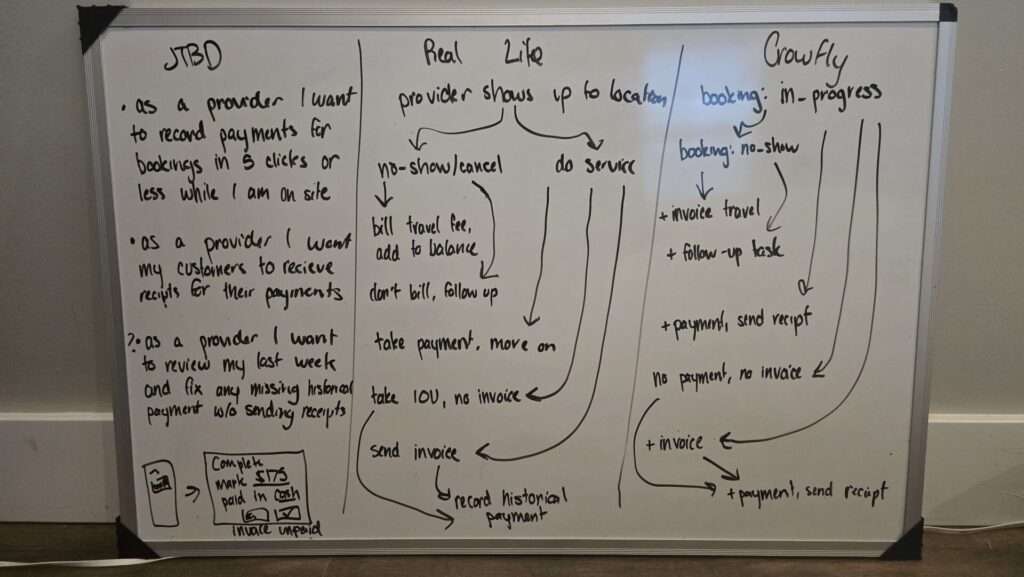
Jacqui: Crowfly actually started as an intelligent booking widget. That was the entire product at first: you’d drop a link in your Instagram or Facebook bio, since our initial customers were running their businesses through social media. It would check your schedule and the travel time to and from an appointment to make sure it actually fit your day.
That widget is still core to what we do, but the more we talked to customers, the clearer it became that it only covers a subset of them, so we’re now building a separate flow for appointments that need an on-site visit or a quote first. We’re also, as far as we know, the only ones offering QuickBooks integration on our standard tier. The moment you start doing business, you need accounting software, and we didn’t want to gate that behind a higher plan.
What did it feel like landing your first paying customer?
Jacqui: Game-changing, in more ways than one. Concretely, we went to the ATM, took out a $20 bill, framed it and put it on the wall. But it was also a real mindset shift.
Nickolai: It’s a lot easier to move fast and break things on a side project. Our clients trust us with a platform that helps them feed their kids and pay their mortgage, and that weighs on me. Going from side project to essential to our clients changed how we build every feature now. We met Brian (Woodward) in May, and he became our first paying customer in August, after starting as a feedback partner with free access to the platform. We hadn’t expected that. It felt incredible, but there’s also real weight to being someone whose business people depend on.

If Crowfly works out the way you’re hoping, what does that look like in five years?
Nickolai: We want growth, but slow and steady wins the race. In the next year or so, we’d love to be around 100 customers. We’ve built the platform; now it’s about customer acquisition.
Jacqui: Year two, we’d love to quadruple that. Further out, it gets more nebulous, but ideally we’re nationwide, supporting every state and major city, with features built and ready for when we hit that scale.
For our customers, the goal is that they never see a degradation in service. Once things are more settled, we’d rather spend our time building new features than fielding support requests because something broke.
As multi-time founders in Indianapolis, what do you think people misunderstand about founders like you?
Nickolai: Tech founders often want to just build a product and hope it sells itself on its own merits, because that’s the easier path. It doesn’t work that way.
I’ve never been a founder anywhere other than Indianapolis, but I’ve talked to people who’ve built companies on the coasts, and the early-stage founder culture here is genuinely strong, the camaraderie and cooperation across sectors, from solo founders at TechPoint’s Indiana Founders Network meetups up to CEOs and CTOs of large companies who stay involved with the local community.
Jacqui: What people might not expect is just how hard it is. Having an idea and building it is one thing. Getting it into the hands of people who’ll actually use it, and pay for it, is a completely separate challenge. That’s the real turning point.
Nickolai: You don’t need a perfect product. There’s more value in getting a product into someone’s hands and polishing it afterward. Networking is a huge part of that. We can trace a direct line from where we are today, back through our first customer, to our very first TechPoint meeting.
So far, Crowfly’s path has run in parallel with its founders’ own working relationship: a bet made on the strength of two different vantage points of the same problem, built without outside funding, one customer at a time. With that first $20 bill still framed on the wall, Peterschmidt and Christiansen are betting the next few years look like the last few: steady and customer-led, built on the same Indianapolis network that got them their first customer in the first place.
Register for Venture Connect by October 1
It’s like speed-dating between startups and investors. Find your match November 4.