Case Study: How K1x Used AI to Modernize Tax Form Processing
From Bottleneck to Breakthrough: How K1x Used AI to Modernize Tax Form Processing
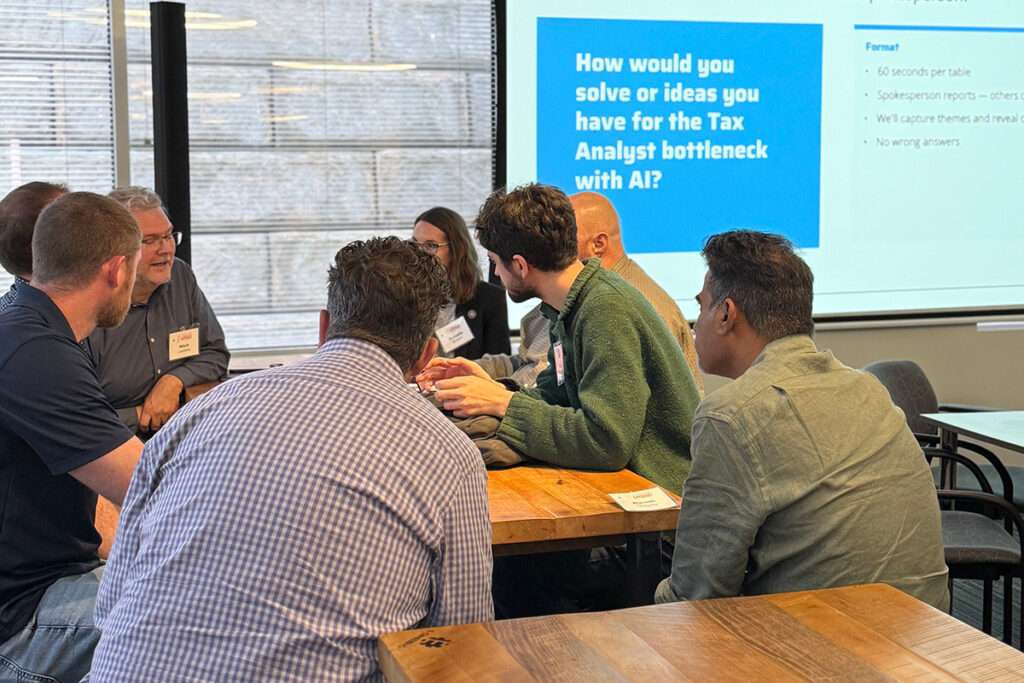
On May 27, members of the TechPoint AI Innovation Network gathered at E-gineering’s Indianapolis office to hear how a small company found a way to do the near-impossible: keep pace with hundreds of tax forms across dozens of jurisdictions without dramatically growing its team. Leading the conversation was Neal Schneider, chief technology officer and co-founder of K1x.
Their story was not one of sweeping transformation or an overnight fix. It was a story about identifying exactly where the pain was, asking the right questions and building focused tools that made skilled people more effective. As Neal put it to the room: “the classic business analyst skill just got really important.”
About K1x
K1x is a tax automation platform headquartered in Morristown, NJ. The company’s software is built specifically to handle specific tax documents called Schedule K-1s, and 990s. They are complex documents that flow between investment partnerships, large accounting firms and institutional investors.
K1x is used by 20 of the top 25 accounting firms in the country, including two of the four largest in the world. It also serves more than 150 universities, endowments and large-scale investors. The platform automates the collection, review and filing of these tax documents across 47 state and federal tax authorities.
Setting the Stage
Every year, K1x must update its software to reflect new tax filing requirements issued by the IRS and state governments. By April 1 of each year, those updates need to be live and ready for clients to use. Missing that date means clients cannot file on time, which triggers a wave of urgent support calls and damages the trust K1x has built over years of reliable service. There is no flexibility on this deadline.
On April 1, 2024, K1x only had 65% of its forms ready. With more than 400 forms to process and just two tax analysts on staff, the math was not working. Something had to change.
Rather than hiring more people, the team asked a different question: where exactly is the time going, and can AI help? This case study explores how K1x partnered with E-gineering, an Indianapolis-based technology consulting firm, to answer that question and build a set of targeted AI tools that moved the needle in a meaningful way.
Overview
K1x and E-gineering built three narrowly focused AI tools in six weeks. Each tool was designed to eliminate a specific bottleneck in the annual tax form update process. The tools were built largely by interns, powered by an AI system (Claude) and integrated directly into K1x’s existing software platform so analysts could use them without switching between different applications. Human analysts remained in the loop at every step.
The results, measured against the company’s most critical business deadline, were clear:
Industry Context and Business Challenge
The tax preparation industry runs on a calendar that waits for no one. Each year, the IRS and state taxing authorities update their forms. Sometimes the changes are significant. Sometimes only a few small details shift. For a company like K1x, whose entire platform is built around processing these forms accurately, every change must be found, analyzed and incorporated before filing season begins.
The scale of the challenge at K1x is striking. The company manages more than 410 tax forms across 47 jurisdictions. Each form update triggers a 23-step process that spans intake, analysis, development, approval and final release. Even getting started requires back-and-forth communication with tax authorities by email or mail to confirm which forms K1x will support that year. New forms arrive without warning. As Neal described it, “one day they just randomly pop in.”
At the center of the workflow sits the tax analyst. These are the people responsible for translating dense government instructions into clear rules from which software engineers can build. Most of K1x’s analysts are former CPAs who worked in public accounting. They are deep experts who understand tax law, know how to communicate with government agencies and can answer the kinds of technical questions that come up mid-project.

“The constant narrative that AI means we do not need people is simply not how it played out at K1x.”
Neal Schneider CTO and Co-Founder, K1x

The scale of the staffing challenge becomes even clearer when you look at the competition. Traditional tax compliance software companies employ 300 or more software developers and over 100 form analysts. At K1x, that same function ran with just two people.
With two analysts handling more than 400 forms, three specific steps in the workflow created the most friction.
Pulling Formatting Rules
Analysts had to read through handbooks exceeding 100 pages per jurisdiction just to find the handful of specific formatting requirements that applied to K1x’s work.
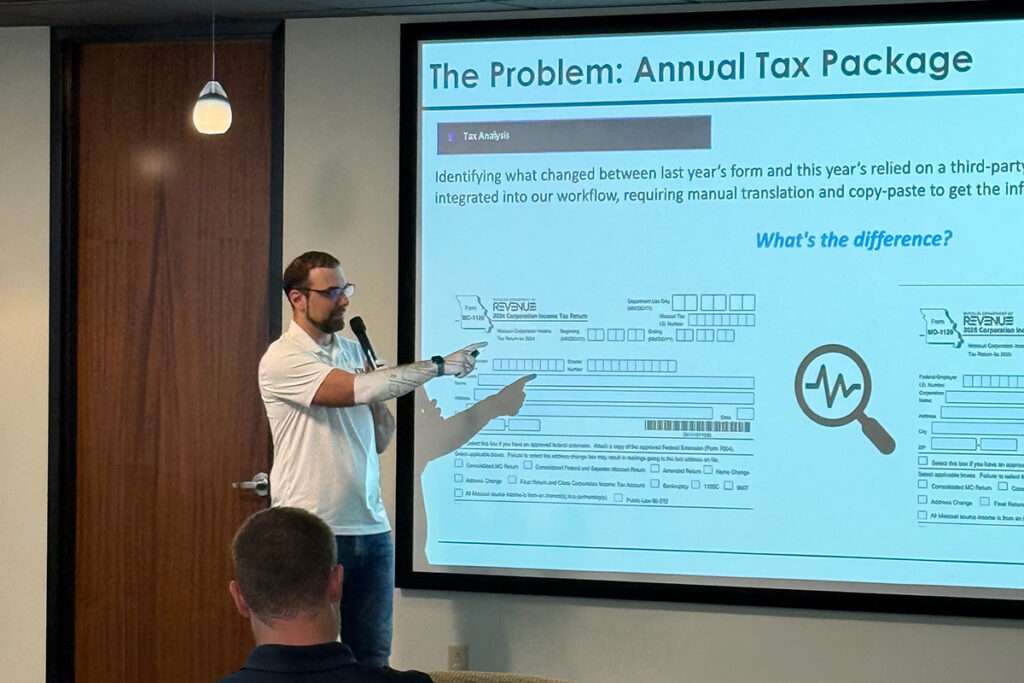
Comparing Forms Year-Over-Year
The team’s comparison tool could show where forms had changed but not what those changes meant, so an analyst still had to interpret each difference and manually log it into the engineering team’s project management system.
Mapping Fields Inside Fillable PDF Forms
Government agencies often assigned random or meaningless names to form fields, so someone had to manually rename everyone across more than 400 forms containing an estimated 65,000 individual fields.
Together, these three tasks consumed most of the team’s time during the most critical stretch of the year. The 65% completion rate in April 2024 made clear that the existing approach could not keep up.

AI Implementation Strategy
Before writing a single line of code, the K1x and E-gineering teams mapped the workflow carefully. The instinct in many organizations is to reach for a broad AI solution that handles everything at once. However, Neal was drawn to the idea of eventually using K1x’s institutional knowledge, including years of historical documentation and correspondence with tax authorities, to give the company a long-term competitive advantage. That is still a goal. But improvements were needed now.
So, the team made a practical decision: start simple, understand the process and let the actual work define the tool. Rather than building one large AI system meant to handle everything, the team built three smaller tools. Each one was scoped to address a single issue. Each used Claude as its AI engine, accessed through an application programming interface (API), which is essentially a way for software systems to communicate with each other.
The guiding principle throughout was that AI should extend what the analysts could do, not replace the judgment they brought to the work. As the team put it, throwing everything at AI without first understanding the process and the data puts an organization at risk of making its problems worse.
The team also made a deliberate decision to keep human oversight at every step. AI-generated outputs would always go to an analyst for review before moving forward. This was not a lack of confidence in the technology. It was a recognition that tax compliance carries legal and financial consequences and that a review step protects both K1x and its clients.
Solution and Implementation
The three tools were built in six weeks by E-gineering interns who had worked with the K1x engineering team the previous summer. All three were integrated directly into the K1x platform so analysts could use them within their existing day-to-day workflow.
The first tool addressed the handbook problem by uploading each jurisdiction’s formatting guide and running it through a Claude-powered process that answered a standardized list of questions covering font size, date formats, scanning requirements and other rules. Instead of reading more than 100 pages, an analyst now received a pre-filled summary to confirm or correct, and results were pushed automatically into Jira without any manual copying.
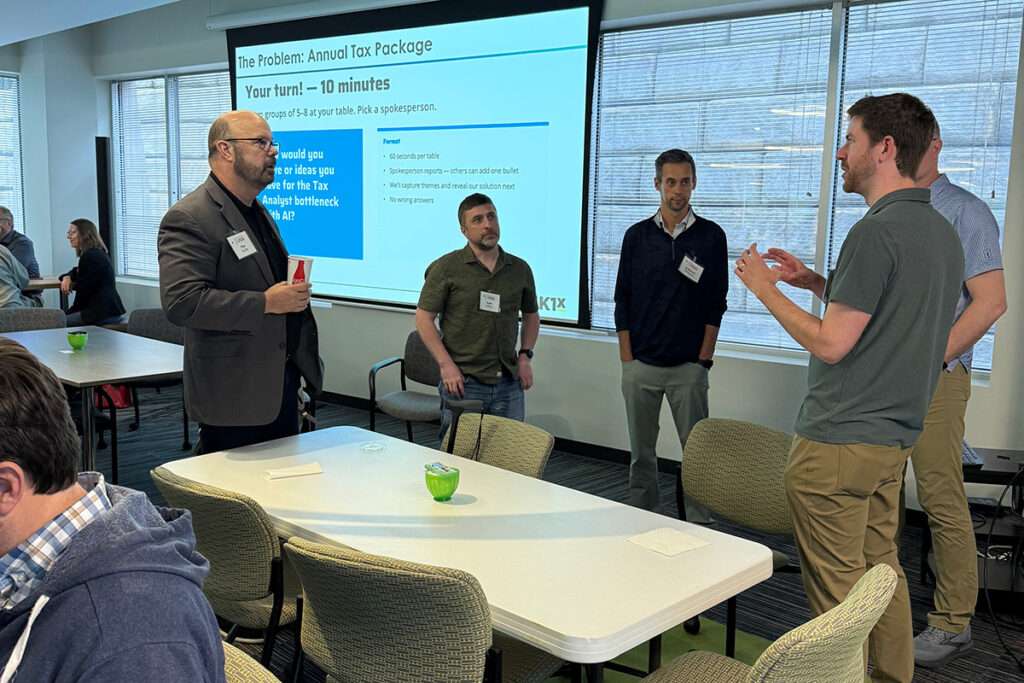
The second tool tackled year-over-year form changes by having an analyst upload both versions of a form, then using Claude to produce a plain-language summary explaining what each change actually meant rather than just where differences appeared visually. That output was pushed directly into Jira, giving developers actionable information in the system they already used and eliminating the team’s dependency on a third-party comparison tool entirely.
The third tool, demonstrated live at the TechPoint event, addressed the most time-intensive step in the workflow. If K1x had processed the same form the prior year and it had not changed, the tool automatically carried over existing field names. If the form was new or updated, it converted each page into an image, numbered every field and sent those images to Claude, which assigned clear names based on K1x’s established naming conventions. An analyst could then review and correct the output through a chat interface. The tool performed especially well on structured grids with repeating patterns and was expected to improve each cycle as more unchanged forms were handled automatically.
Outcomes
The results from the first full release cycle using these tools were significant across every metric K1x tracked.
97% of forms were completed by April 1 – a striking increase from 65% the year prior. That 32-point improvement represented the difference between a stressful filing season and a smooth one, for both the K1x team and its clients.
The 71% reduction in support tickets between April 1 and May 15 told the rest of the story. Fewer incomplete forms meant fewer clients calling with urgent problems. The team spent less time in reactive mode and more time focused on improving the platform.
Perhaps the most strategically important result was that 42% of forms were delivered to clients earlier than the prior year. In a market where speed and reliability are key differentiators, getting forms into clients’ hands ahead of schedule gave K1x a competitive edge that went beyond simply meeting the deadline.
At the same time, the scope of K1x’s work grew by roughly 25% during this same period. The team handled more forms than ever before while improving on every performance measure. That combination, more work done better with a team that grew modestly rather than dramatically, is perhaps the clearest illustration of what the AI tools made possible.
Conclusion
K1x’s experience offers a practical lesson about what makes AI useful in a specialized, high-stakes environment. The team did not start with a vision for sweeping transformation. They started with a deadline they were up against and a clear look at where their workflow was breaking down.
By building narrow, task-specific tools, keeping human oversight at every step and integrating those tools directly into their existing platform, K1x turned a persistent capacity problem into a competitive advantage. The approach was deliberate and disciplined: map the process first, find the friction and build for that friction specifically.
The most honest moment of the event came when Neal addressed the question everyone in the room was thinking about: did AI eliminate the need for people? The answer was clearly no. Two analysts became four. Scope expanded. What changed was the ratio of judgment to manual extraction in each analyst’s day, and that shift made the whole operation more scalable without requiring a team size that would have been impossible to justify.
For organizations navigating their own AI journeys, the takeaway is less about technology and more about approach. Understand your process before you build anything. Find the specific friction points. Measure success against something that actually matters to your business. And treat AI as a tool for extending human expertise, not replacing it. That practice, more than any particular AI model or platform, is what drove the results at K1x.
Key Takeaways for Organizations
Map your process before you build anything. K1x spent time designing the system and understanding the data flows before beginning the project. Without that foundation, deploying AI produces confusion rather than results.
Build narrow tools for specific problems. Three small tools targeted at three specific friction points outperformed what a broad AI solution would have achieved. Specificity drives value.
Keep humans in the loop. Every AI output at K1x went to a trained analyst for review before moving forward. This was not a limitation of the tools. It was what made them trustworthy in a compliance context.
Measure what matters. The April 1 deadline was the real test. Tying AI implementation directly to a business outcome made success easy to define and impossible to argue with.
AI does not replace people; it changes their work. K1x grew from two to four analysts while also expanding scope. AI shifted the mix of work toward judgment and away from manual extraction, making each analyst more effective rather than redundant.
A note on process transparency: This case study was drafted with AI assistance and reviewed and edited by a human author.
Keep Reading
Explore more AI Innovation Network case studies and TechPoint resources on artificial intelligence.
AI Innovation Network Case Studies
- Milestone: Using AI to Create Your Company’s First AI Policy
- How M2N’s MPower Uses AI to Power Skills-First Talent
- Building Data Integrity for Enterprise AI, Featuring Cummins
- How SEP Uses AI Across the Software Delivery Process
More From TechPoint
Find more AI resources, events and opportunities to connect with Indiana’s AI ecosystem.
Join The AI Innovation Network Visit TechPoint’s AI Hub