Case Study: When Connectors Reveal the Truth: Building Data Integrity for Enterprise AI
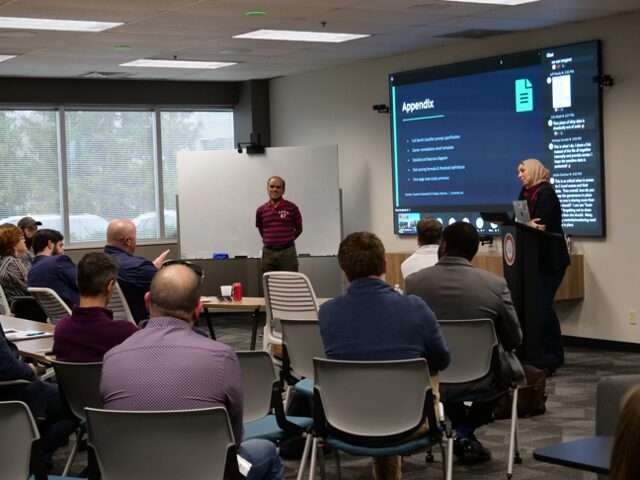
On March 25, 2026, members of the TechPoint AI Innovation Network gathered for a closer look at how enterprise AI moves from concept to impact. Leading the conversation were Manjunatha Sivanna and Suzanne Kawamleh of Cummins Inc. (Cummins), who shared an inside perspective on the company’s AI journey.
Rather than focusing solely on models or tools, their story centered on a foundational question: how do you ensure your data is truly ready for AI? Through their experience, Cummins revealed that the success of AI implementation begins not with algorithms, but with a disciplined approach to data integrity.
Company
Cummins is a global company headquartered in Columbus, Indiana. Cummins designs, manufactures and services diesel engines, electric power systems and emerging clean energy technologies. Its products and services support a wide range of industries through an extensive network of distributors and dealers across nearly 190 countries and territories.
Introduction
When Cummins accelerated its enterprise-wide AI initiatives, the vision was clear: enable faster, more informed decision-making, unlock institutional knowledge and empower employees with intelligent, data-driven tools. Like many organizations at this stage of digital maturity, Cummins had already invested significantly in modern infrastructure, cloud adoption and collaborative work environments.
As these AI capabilities evolved, the organization recognized an important inflection point. Advancing AI outcomes was no longer primarily about deploying new models or tools, it required a deeper understanding of the data across the company. This realization highlighted an opportunity to strengthen data readiness through more proactive discovery, improved governance practices and enhanced visibility into how information was structured and accessed across the enterprise.
This case study explores how Cummins leveraged AI-enabled insights to identify opportunities for greater data stewardship and governance maturity. They transformed that awareness into a scalable approach that emphasizes structured data management, consistent labeling, retention strategies and access hygiene to reduce risk and support long-term AI success.
Industry Context and Business Challenge
Across industries, organizations are rapidly advancing AI adoption, yet many encounter a common inflection point: while data is abundant, it is not always structured or governed in ways that fully support reliable AI outcomes. Large volumes of unstructured content such as documents, emails and presentations often lack consistent classification, lifecycle management, and access controls, limiting their effectiveness in AI-driven environments.
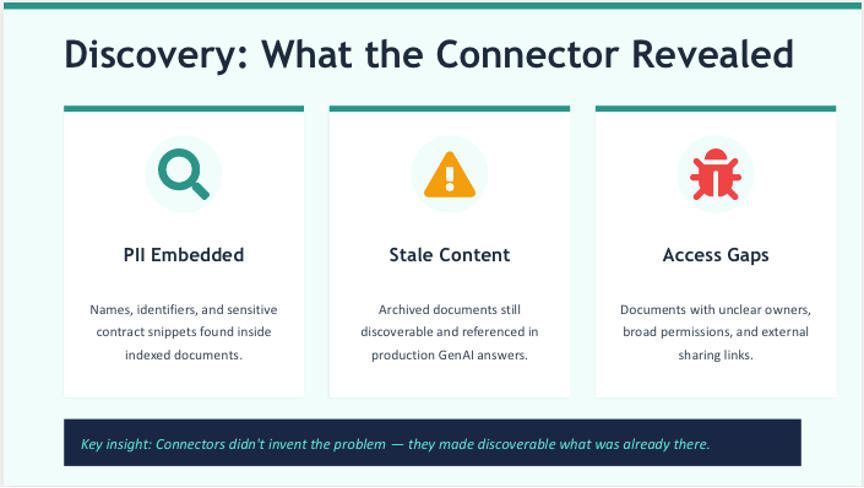
At Cummins, this opportunity became more visible as AI connectors were introduced to integrate enterprise knowledge sources with emerging AI tools. The goal was to ground AI-generated insights in trusted internal information, improving relevance and consistency across use cases.
Through this integration, the organization gained enhanced visibility into its broader data landscape. AI-enabled discovery highlighted opportunities to strengthen governance practices, including improving content lifecycle management, clarifying ownership and standardizing access controls. In some cases, information that was no longer aligned with current business practices surfaced alongside more relevant content, underscoring the need for stronger retention strategies and content curation.
Importantly, these insights did not represent new challenges, but rather a clearer view of existing conditions within a rapidly evolving digital environment. AI served as a catalyst for proactive discovery bringing greater transparency to how information was organized, accessed and maintained across systems. Put more simply, this meant understanding what data they had, who owned it and whether it could be trusted.
This moment created a strategic opportunity to advance governance maturity, or how well data is managed, in three key areas: strengthening confidence in AI-driven outputs, enhancing consistency in how information is managed and accessed, and reinforcing enterprise-wide trust in data-driven tools. The central question became: how can the organization scale AI capabilities while embedding governance, labeling, retention, and access hygiene practices that reduce risk and support long-term value?
AI Implementation Strategy
Rather than limiting AI adoption, Cummins took a forward-looking approach focusing on strengthening its data foundation in parallel with continued innovation. The strategy centered on four key actions designed to enhance visibility, governance maturity, and risk reduction at scale:
- First, proactive discovery at scale: The organization implemented broad, AI-enabled discovery across enterprise repositories to gain deeper visibility into its data landscape. This approach surfaced opportunities to improve content quality, clarify ownership and better align information with current business needs establishing a more transparent and manageable data environment.
- Second, intelligent data classification: By leveraging advanced pattern recognition and contextual analysis, data was categorized in a more structured and meaningful way. This enabled more consistent handling of information and laid the groundwork for scalable governance practices across systems.
- Third, labeling to drive consistent controls: Labels were applied as a foundational governance mechanism supporting standardized access management, guiding retention practices and promoting consistent data handling behaviors. This helped embed governance directly into day-to-day workflows while reducing variability across the organization.
- Fourth, continuous monitoring and adaptation: Recognizing that data environments are dynamic, the organization established ongoing monitoring practices to maintain visibility and responsiveness. This allowed teams to identify emerging risks, refine controls and continuously strengthen governance as the data landscape evolved.
This approach marked an important shift in perspective. The objective was not to slow AI progress, but to enable it more effectively by ensuring the data that powers AI is well-governed, structured, and aligned to support reliable, scalable outcomes.
Solution and Implementation
The team began its efforts with a comprehensive discovery phase, leveraging metadata insights such as document age, ownership and sharing patterns to better understand how information was created, used and maintained across the organization. This AI-enabled visibility provided a more complete picture of the data environment, highlighting opportunities to improve structure, relevance and stewardship at scale.
As governance practices were introduced, early efforts to apply highly prescriptive controls revealed an important insight: sustainable governance requires alignment with how employees work. This realization became a pivotal moment in shaping a more effective, adoption-focused strategy.
Rather than enforcing rigid requirements, Cummins evolved toward a more intuitive and user-centered model. Default labeling was introduced to simplify decision-making, complemented by clear guidance and ongoing education. This approach helped employees better understand how governance practices; such as classification, labeling and access management support both usability and risk reduction. Over time, this led to stronger engagement and more consistent adoption across the organization.
Building on this foundation, a lifecycle management framework was implemented to ensure information remained aligned with business needs. Data was guided through each stage, from creation and active use to archival and disposition supported by structured retention practices. This not only improved data relevance and accessibility but also reinforced long-term governance consistency.
Equally important was the integration of governance into everyday workflows. When opportunities for improvement were identified, content owners received clear, actionable notifications with simple resolution options; such as updating access, refining classification or aligning content with retention guidelines. This streamlined approach reduced friction and made governance a practical, embedded part of daily operations.
Pilot programs played a key role in refining this model. By starting with targeted groups, the team was able to iterate, improve accuracy and build organizational confidence creating a scalable foundation for broader adoption of governance best practices.
Outcomes
The impact of these efforts was meaningful for Cummins, reflecting both technical advancements and broader organizational value. From a data and governance perspective, the organization achieved greater visibility into its information landscape along with improved consistency in how data was classified, managed and accessed. Enhanced monitoring and refined controls supported more efficient workflows and strengthened overall data stewardship.
From a business standpoint, one of the most important outcomes was increased confidence in AI-enabled tools. As governance practices matured and data quality improved, employees experienced more relevant and reliable outputs reinforcing trust in AI as a valuable decision-support resource. The alignment of data lifecycle management, labeling and access controls contributed to more consistent and dependable results.
At the same time, strengthened governance practices helped reduce risk by ensuring that information was more appropriately managed and accessible to the right audiences. Employees benefited from greater clarity and assurance that structured safeguards such as labeling, retention and access hygiene were actively supporting responsible data use.
As with any enterprise-wide transformation, ongoing refinement was essential. Continuous tuning improved the accuracy and effectiveness of governance controls while change management efforts supported long-term adoption. Ultimately, the integration of technology, process and user engagement established a scalable and sustainable foundation for responsible AI growth.
Conclusion

Cummins’ experience highlights an important truth about AI adoption. AI does not introduce new data challenges. It brings greater visibility to opportunities that already exist within the data environment.
By embracing this perspective, the organization turned increased visibility into a strategic advantage. Through automated classification, structured lifecycle management and user-centered governance practices, Cummins strengthened its data foundation in a way that supports scalable innovation and long-term risk reduction.
For organizations advancing their own AI initiatives, the takeaway is clear: success depends not only on the capability of AI tools but on the quality and governance of the data that powers them. While new processes and technologies often require adjustment, those that invest in governance maturity, proactive discovery and data integrity will be better positioned to realize the full value of AI.
Key takeaways for small businesses
- Know what data you have
- Clean up outdated files
- Decide who can access what
- Start simple with labeling and organization
Keep Reading
Read More AI Innovation Network Case Studies
How SEP Uses AI Across the Software Delivery Process →
How Baker Hill Used AI to Boost Employee Efficiency by 30% →
The Art of the Constraint, featuring Data 317 →
More from TechPoint on Artificial Intelligence
Join the AI Innovation Network →
Sponsor the Indiana AI Innovation Network
Advance Indiana’s tech future by backing programs that develop talent, spark ideas, and grow startups. Find out how to become a sponsor.