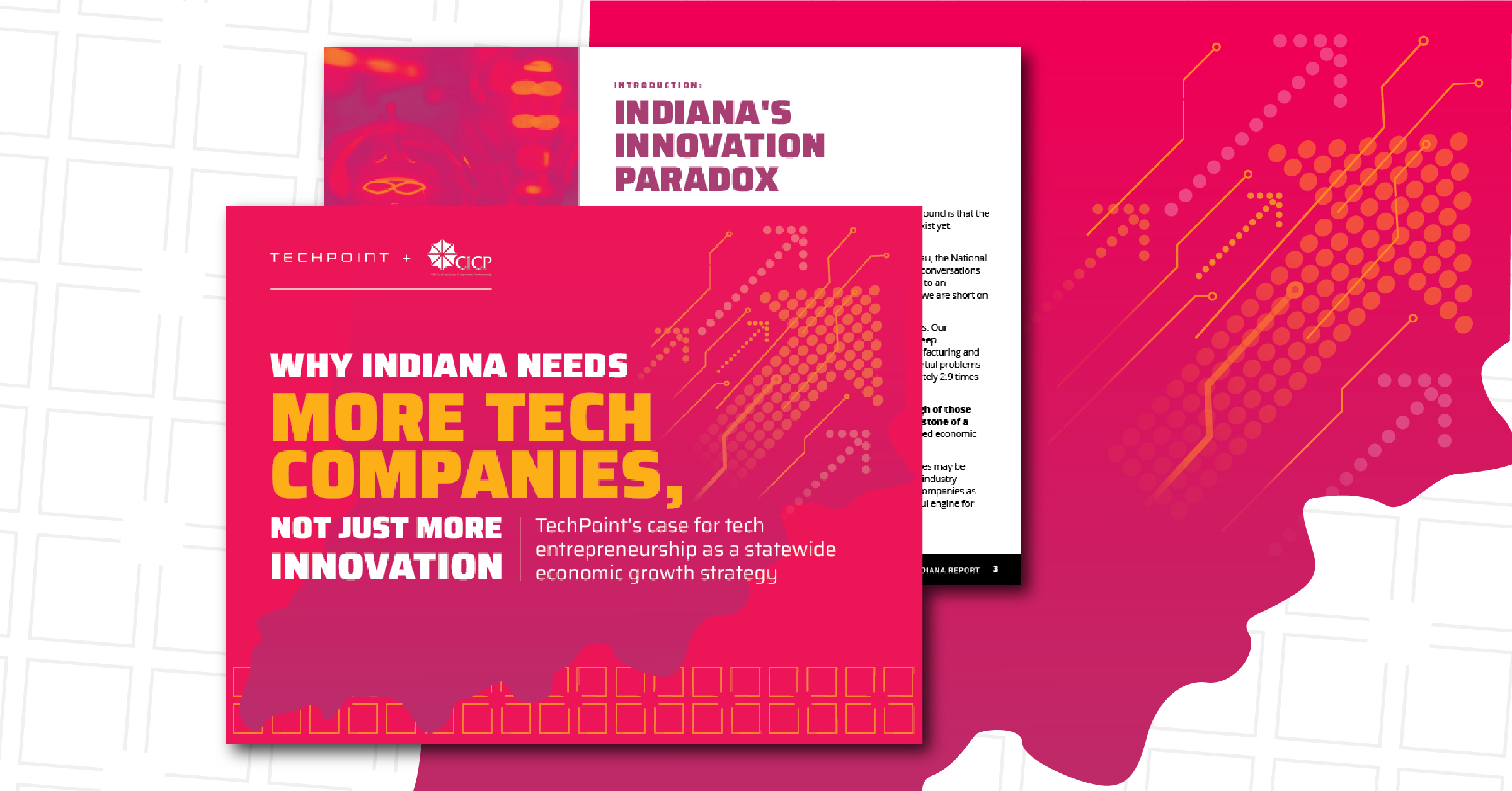
Indiana Needs More Tech Companies, Not Just More Innovation
New report looks at how Indiana can produce more breakout tech companies to power state’s next era of economic growth
INDIANAPOLIS (Oct. 22, 2026) — TechPoint today released Why Indiana Needs More Tech Companies, Not Just More Innovation, a new report examining entrepreneurship, research and invention, venture capital activity, and the experiences of founders and ecosystem leaders across Indiana.
The report finds that Indiana has the research, talent and industry expertise to build significantly more high-growth technology companies, but is not yet converting enough of those assets into startups and growing companies.
The findings will frame the conversation at TechPoint’s Community Connect on Nov. 4, where TechPoint will discuss the report and launch a broader strategic direction informed by its research and months of stakeholder conversations.
“Indiana has tremendous assets, including generations of industry expertise, world-class universities, groundbreaking ideas and talented people, but we have work to do,” said Eric Christopher, president and CEO of TechPoint. “This report gives us a much clearer picture of where the gaps are. Now, we need to rethink how we connect entrepreneurship, capital, talent and economic development so Indiana can build the next generation of companies at the pace this moment demands.”
The report presents a mixed picture of entrepreneurship in Indiana. In 2025, Indiana ranked 16th nationally in the rate of new entrepreneurs and ninth in one-year startup survival. At the same time, the state ranked 45th in first-year startup job creation, with new businesses generating 3.73 jobs per 1,000 residents.
Indiana’s economy also relies more heavily on established companies than the nation overall. Firms younger than five years make up 30% of Indiana businesses, compared with 36% nationally, while firms older than 16 years make up 40% of Indiana businesses, compared with 31% nationally. Only 8% of Indiana’s workforce is employed at firms younger than five years.
As part of the research process, TechPoint convened technology leaders, founders, investors, corporate executives and ecosystem leaders to examine why Indiana is not producing more breakout technology companies. Those conversations identified recurring gaps around experienced founders and operators, access to customers and capital, stronger founder networks and the need for clearer connections between Indiana’s established industries and its entrepreneurial economy.
The state already has significant programs, resources and organizations supporting entrepreneurs. However, TechPoint’s report finds that founders do not always experience them as a coherent system, making it harder to navigate the path from an idea to a startup and from a startup to growth.
At the same time, Indiana has a significant foundation on which to build. Central Indiana has produced more than 93,000 peer-reviewed research articles since 2015 and nearly 12,900 patented invention families since 2010. Growth-capital-backed startups, however, account for just 1.4% of those patented invention families, highlighting the gap between the region’s ability to generate innovation and its ability to build new companies around it.
“We don’t believe Indiana needs to become the next Silicon Valley, Boston or Austin,” Christopher continued. “Instead, we have an opportunity to build an economy that is distinctly Indiana by applying technology and AI to the industries where our state already has deep expertise, including life sciences, advanced manufacturing, agriculture and food, logistics and supply chain.”
Venture activity also adds urgency. Indiana startups have closed nearly 1,400 venture capital deals worth almost $4.9 billion since 2016, but annual deal count declined from a high of 187 in 2022 to 113 in 2025, the state’s lowest annual total since 2018.
“Indiana isn’t unique in facing venture capital headwinds, as a handful of AI mega-rounds attract a disproportionate share of investment that isn’t reaching a broad set of companies or regions,” said Chelsea Linder, vice president of innovation and entrepreneurship at TechPoint and one of the report’s authors. “Indiana is still in the game, but we need to act, particularly as national capital becomes more selective about where it flows.”
TechPoint will continue the conversation at Community Connect on Nov. 4, where Christopher, Linder and other leaders will discuss the findings and share more about TechPoint’s priorities and direction for Indiana’s technology economy.
About TechPoint
TechPoint is the CEOs of Indiana Corporate Partnership’s branded initiative for Indiana’s tech-powered ecosystem. TechPoint works with public, private, and industry partners to strengthen the tech talent pipeline, enhance resource connectivity for enterprise organizations and startups alike, and elevate the industry by activating the community and amplifying stories of success. For more information, visit techpoint.org.
Media Contact
Lara Beck
lara@beckcommunicationsgroup.com