Earlier this year, TechPoint published AI Amplifies Need to Address the Experience Gap, highlighting research from the Stanford Digital Economy Lab showing that early-career workers ages 22 to 25 in highly AI-exposed occupations experienced a 13 percent relative decline in employment from late 2022 to mid-2025.
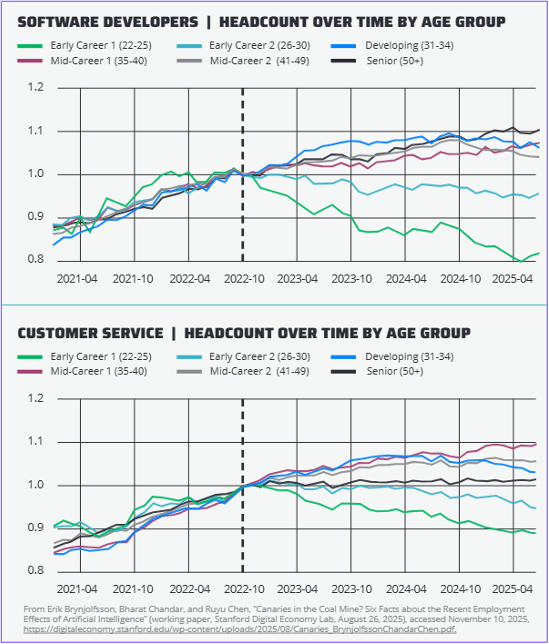
From my vantage point, it is not a collapse of tech work, at least not at this moment. It is, however, a redistribution of opportunity by experience.
AI systems perform well on codified tasks. These are routine, rules-based and well-documented activities. Historically, those tasks formed the entry point for early-career professionals. They were how graduates moved from theory into production.
Tacit knowledge develops differently. Architectural judgment, trade-offs, debugging complex failures and coordinating across teams require exposure to real work and feedback/coaching from managers and peers.
As AI increases the value of tacit capability, experience becomes a critical asset, and the structural pathways that once provided an on-ramp are no longer operating by default.
A Shift is Happening in Real Time
We are not theorizing about this dynamic; we are hearing it and seeing it locally.
In conversations with an engineering leader at a growing Indiana-based product company, the tone around AI has changed notably in the past six months. Last fall, he described AI as assistive. It was a productivity tool that required management and significant oversight. As the product scaled, he assumed the engineering team he managed would continue to grow alongside it.
Today, the calculus is different. He now describes a model in which a smaller group of experienced engineers oversee AI-enabled systems capable of completing many foundational coding tasks at high quality without the coordination overhead that comes with adding additional personnel. The oversight has not disappeared, but the efficiency of coordination has increased.
As a result, the conversation has shifted. The question is no longer simply “How do we add more developers?” but rather “Where are the new bottlenecks, and how should we structure the team around them?” In practice, this may mean fewer engineers than in previous years, or engineering capacity supporting a larger share of product or commercial activity.
This shift was triggered by the release of Claude Opus 4.5 in December.
This same company previously considered hosting an intern through the Xtern program. For now, they have decided to pause while evaluating how AI models evolve. If senior engineers can review AI-generated output more efficiently than they can train a novice, the incentive to hire at the entry level weakens.
At the firm level, this is a rational response to new tools and changing coordination costs. Replicated across firms, however, it reshapes how people first enter the profession, a dynamic increasingly visible as AI changes how foundational work gets done.
What Our Own Data Shows
While one company’s decision could be dismissed as isolated, participation trends across our flagship tech internship program show a similar direction. Employer hiring through Xtern has declined by nearly 50% since 2023.
This signals contraction in employer-sponsored early-career opportunities over a short period of time.
Few organizations publicly share directional participation data. We believe it matters. When employer demand for structured entry-level experiences declines while expectations for tacit capability rise, pressure concentrates at the transition from education to work.
Students still need experience to build judgment. Employers increasingly prioritize hiring those who already possess it. This is the structural tension.
This is an Experience Design Problem
For decades, the professional on-ramp followed a relatively stable design. Early-career workers handled low-risk tasks, observed experienced colleagues, received feedback in real time and gradually assumed greater responsibility.
Two shifts are now interacting:
AI is Absorbing Routine Work
Many of the tasks that once justified junior hires can now be completed by AI systems under senior supervision.
It is important to note that we may not yet see formal restructuring of teams or widespread reductions in entry-level hiring across every business. In many organizations, job titles and headcount plans still look familiar. But if we are honest about how we are working, the shift is visible in smaller ways.
Increasingly, leaders, colleagues and peers refer to their AI tool as if it were a “thought partner” or “teammate.” They give it meaningful work. They iterate on the output quickly. They refine prompts and receive revised drafts in minutes. The feedback loop is immediate and low friction.
Personally, I find myself using AI in ways that resemble how I might have once used an exceptional intern. I delegate the first draft. I review and refine. I push it further. The iteration cycle is faster than it would be with a human learner, and it requires less development overhead.
That does not make AI a replacement for human growth. But it does change the economic and practical calculus of who receives foundational tasks.
The Structure of Work Itself Has Changed
Hybrid and remote models reduce incidental learning. Managers face more significant delivery expectations and have limited coaching bandwidth. Supervising an intern requires intentional time and design, not just proximity.
These forces compound.
If low-risk tasks are off-loaded with AI and informal exposure declines, the traditional learning rung weakens. Entry-level roles are more likely to require production-ready output from day one, while managers have less capacity to develop novices into contributors.
This is not an argument against remote work. Remote environments can support development. But they require explicit architecture. Mentorship, pairing, feedback loops and staged responsibility must be designed, not assumed.
AI has not eliminated the ladder into professional work. It has altered the economics of the lower rungs. Remote and hybrid structures have altered the conditions under which those rungs are built.
Without deliberate reconstruction, fewer early-career professionals accumulate the tacit capability firms increasingly value.
A Direct Opportunity for Employers
If AI is absorbing routine work, employers have a choice. They can allow that work to disappear from the experience ladder, or they can redirect foundational projects, things like documentation, workflow mapping, internal tooling, data hygiene, AI prompt libraries and process optimization to exceptional interns and early-career talent. These efforts may not drive next-quarter revenue, but they strengthen the system.
Hiring a strong intern to own this work is strategic leverage. The organization improves its operational foundation while the intern gains exposure to real systems and stakeholders. If AI raises the premium on tacit knowledge, internships must be designed as tacit knowledge accelerators, rebuilding the lower rungs of the ladder with intention.
Related Reads
Seizing the Moment: Turning Early Career Talent into Real Business Impact
Key Takeaways from TechPoint’s Talent Panel at BOLT
How Indiana Can Lead in the Age of AI: Insights from TechPoint’s AI Workforce Report
Readiness to Results in the Age of AI: Four Imperatives for 2026